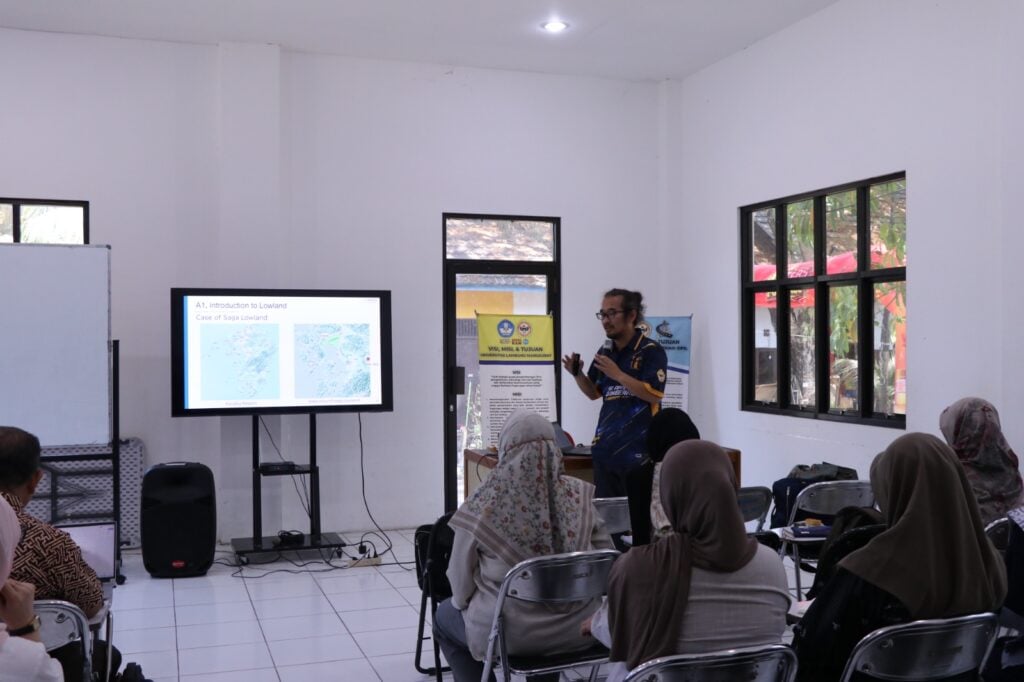
Banjarbaru, 5 September 2026 — The Doctoral Program in Sustainable Engineering, Faculty of Engineering, Universitas Lambung Mangkurat (ULM), hosted an international guest lecture featuring Dr. Yuichiro Mishima from Saga University, Japan, on Saturday, 5 September 2026.
The lecture, held at the Civil Engineering Study Program, ULM Banjarbaru, was attended by lecturers of the Faculty of Engineering, doctoral students of the Sustainable Engineering Program, and students of the Master’s Program in Civil Engineering.
Dr. Mishima delivered a lecture on “Environmental Management of Lowland Areas”, with a broader presentation entitled “Smart Lowland for Sustainable — Introduction to Lowland Technology and AI Usage.” Drawing from his academic and practical experience in Saga, Japan, he explained how various environmental and engineering problems in lowland areas have been addressed through an integrated combination of field understanding, appropriate technology, monitoring systems, and data-based decision-making.
One of the key points of the lecture was that sustainable engineering does not always require expensive or highly sophisticated technology. Dr. Mishima emphasized the importance of developing smart technologies that are simple, affordable, practical, and accessible, particularly for lowland and wetland environments where local conditions can be highly dynamic.
Saga Prefecture itself provides a relevant example. As a low-lying region facing challenges related to water management, drainage, tidal influence, and environmental monitoring, the area has developed various approaches to manage lowland conditions more effectively. Through these experiences, Dr. Mishima illustrated how engineering solutions should be adapted to local environmental characteristics rather than relying solely on standardized technological approaches.
The discussion became particularly relevant to South Kalimantan when Dr. Mishima introduced the potential application of Artificial Intelligence (AI) and low-cost smart monitoring technology for tidal measurements in wetland areas. South Kalimantan is characterized by extensive rivers, tidal wetlands, peatlands, and other lowland environments, making accurate and continuous monitoring of water-level fluctuations an important component of environmental and infrastructure management.
He explained how smart sensors, data acquisition systems, and AI-based analysis could be combined to support the observation and interpretation of tidal patterns. Such an approach may provide more efficient and affordable alternatives for long-term environmental monitoring, while generating valuable datasets for research and decision-making.
The lecture also highlighted the importance of connecting technological innovation with the actual needs of local communities and environmental conditions. Rather than viewing AI as an isolated advanced technology, participants were encouraged to understand it as a supporting tool that can improve measurement, pattern recognition, prediction, and engineering decision-making.
According to Prof. Dr.-Ing. Ir. Yulian Firmana Arifin, Coordinator of the activity and Head of the Doctoral Program in Sustainable Engineering, the topic is highly relevant to the academic orientation of the doctoral program.
“The experience of Saga provides an interesting reference for us because both Saga and South Kalimantan face challenges associated with lowland and wetland environments. What is particularly valuable is the idea of combining sustainable engineering, affordable smart technology, and artificial intelligence with real environmental problems,” he said.
The guest lecture also provided an opportunity for students and lecturers to discuss the similarities and differences between lowland management in Japan and wetland environments in South Kalimantan. These discussions opened possibilities for future research, particularly in the areas of smart environmental monitoring, water management, peat and lowland engineering, and AI-assisted data analysis.
Through international academic activities such as this guest lecture, the Doctoral Program in Sustainable Engineering at Universitas Lambung Mangkurat continues to strengthen its commitment to developing science and engineering approaches that are internationally connected while remaining closely rooted in the challenges of wetland environments.
The activity is also expected to encourage further academic interaction and potential collaboration between Universitas Lambung Mangkurat and Saga University, particularly in research related to lowland technology, sustainable engineering, environmental monitoring, and artificial intelligence applications.